
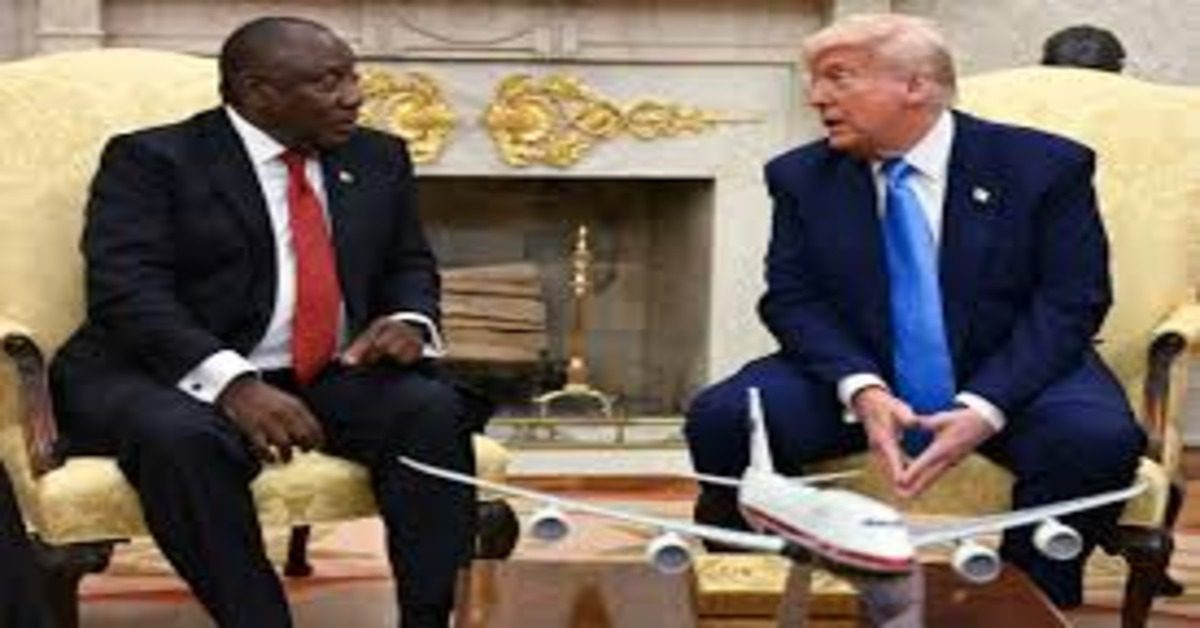
White genocide—a term that continues to ignite fierce debate—turned what was meant to be a friendly diplomatic exchange into a fiery showdown at the White House.
It all began at a routine press conference where former U.S. President Donald Trump met with South Africa’s President Cyril Ramaphosa. But instead of talking about partnership, Trump dropped a bombshell. He accused South Africa of allowing a white genocide to unfold, claiming white farmers were being systematically murdered.
The room fell silent as Trump backed his words with a video. Crosses lining a desolate road flickered on the screen—supposedly marking graves of white victims. It was a dramatic display. But the footage wasn’t from South Africa at all. It came from the Congo. The implication? Entirely misleading.
That moment shifted the tone. A quiet tension swept through the room.
Ramaphosa, however, stayed composed. With a calm voice, he dismissed the claim. “What you saw,” he said, “does not reflect government policy.” He explained that while South Africa is home to a range of opinions, the government does not endorse the narrative of a white genocide.
But Trump wasn’t done.
He brought up South Africa’s land expropriation plan—a policy that has already drawn international scrutiny. According to Trump, the redistribution effort was linked to anti-white violence. Ramaphosa pushed back again, clarifying that most victims of farm-related crimes were Black South Africans, not white. The violence, he said, wasn’t about race—it was about crime.
Trying to lighten the atmosphere, Ramaphosa pointed to members of his delegation: a trio of respected South Africans, including billionaire Johann Rupert. “If there was a genocide,” he joked, “these three gentlemen wouldn’t be here.”
The comment drew a few polite laughs, but the damage was already done.
The incident exposed deeper cracks in U.S.-South Africa relations. Things had already taken a hit earlier in the year when the U.S. granted asylum to 59 white South Africans and put a freeze on essential aid. Many observers criticized the White House for using the white genocide narrative to distract from real diplomatic progress.
The misleading video only added fuel to that fire.
Today, white genocide remains a polarizing term—one that fuels political agendas and stirs international controversy. For some, it represents ignored voices and fear of marginalization. For others, it’s a dangerous myth that deepens racial divides and undermines the truth.
Whatever side you’re on, one thing is clear: when misinformation makes its way into diplomacy, the consequences ripple far beyond a single press conference.
Read latest news on supernews.pk