
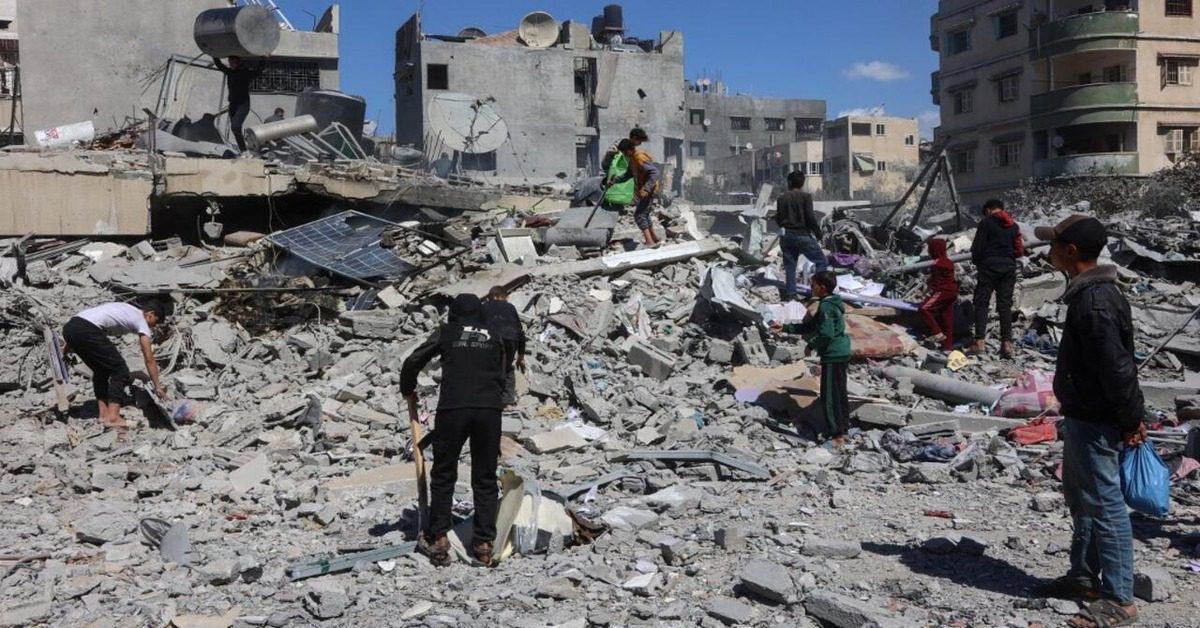
Latest Israeli Strikes in Gaza have once again cast a long, dark shadow over the battered strip. In just 24 hours, at least 38 more lives have been lost, bringing the total death toll to over 100 since Friday, according to Gaza health officials.
Among the victims were a mother and her two children, killed when their tent—meant to be a shelter—was struck in Deir al-Balah. In northern Gaza’s Jabaliya area, five more, including two women and a child, were also killed in a separate airstrike.
The scene, rescuers say, is heart-wrenching.
“We’re digging with our hands,” said Mahmud Bassal, a spokesperson for the civil defence agency. “We don’t have the tools to rescue survivors or recover bodies. The rubble is crushing them, and we can’t lift it.”
The latest Israeli strikes in Gaza spared no one. A pregnant woman lost her life in Nuseirat when missiles struck tents crowded with displaced families. On that same day, the director of civil defence operations, Ashraf Abu Nar, and his wife, were killed when their home was hit.
Earlier in the Jabaliya area, journalist Hassan Majdi Abu Warda and several of his family members were also reportedly killed in their home.
Even humanitarian workers haven’t been spared. On Saturday, two staff members of the International Committee of the Red Cross, Ibrahim Eid and Ahmad Abu Hilal, were killed during a strike in Khan Younis. In a public statement, the ICRC said the deaths “highlight the unbearable cost civilians are paying” and renewed their calls for an immediate ceasefire.
The latest Israeli strikes in Gaza come amid a rapid escalation in military operations. The Israel Defense Forces announced on Saturday that it had hit over 100 targets across Gaza in one weekend alone. This comes even as aid organizations warn of worsening malnutrition and famine among Gaza’s 2.3 million residents.
For almost three months, Israel restricted the entry of food, fuel, and medicine into the region—triggering a humanitarian catastrophe. Under mounting international pressure, Prime Minister Benjamin Netanyahu recently promised to ease the blockade slightly to avoid what he called a “starvation crisis.”
Yet, aid groups argue the relief is too little, too late.
On Thursday, 107 aid trucks carrying essential items made it into Gaza—a mere fraction of what’s needed, according to the United Nations. UN Secretary-General António Guterres didn’t mince words: “Israel has allowed a teaspoon of aid when Gaza needs a flood.”
“The entire population is staring down the barrel of famine,” Guterres added. “And with the latest Israeli strikes in Gaza intensifying, the toll in lives and suffering is growing daily.”
Meanwhile, Israel claims Hamas continues to hijack aid for its own use—an accusation denied by the UN and relief organizations. Simultaneously, the Israeli government has made its long-term intentions clear: it seeks full control of Gaza. It envisions what it calls the “voluntary migration” of large parts of the population. Human rights experts say such a move would likely breach international law.
Since the ceasefire ended on March 18, Gaza’s health ministry reported over 3,785 additional deaths. Since the war began following Hamas’s October 7 attack, more than 53,939 Palestinians have been killed, with women and children making up the majority of the dead.
The latest Israeli strikes in Gaza have flattened entire neighborhoods, leaving about 90% of the population displaced—many of them multiple times. Homes, hospitals, schools—nothing has been spared.
And yet, under the weight of rubble and loss, Gaza still waits for peace, aid, and justice.
Read latest news on supernews.pk