
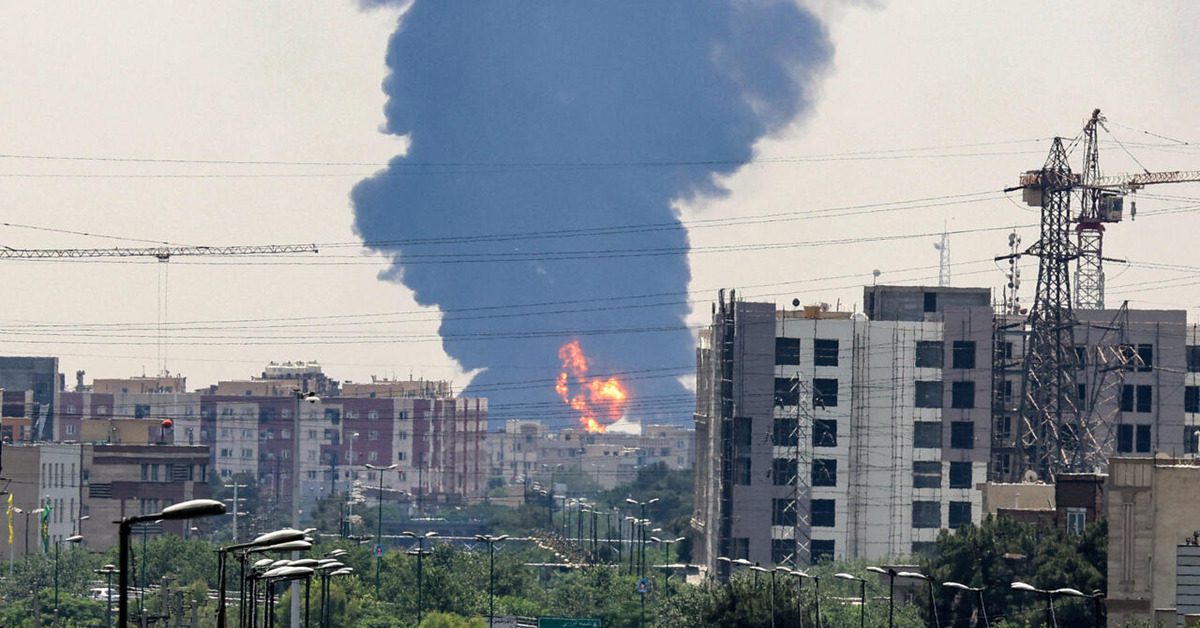
Iran missile strike on Israel has plunged the Middle East deeper into chaos as the deadly air war between the two rivals escalated for a sixth straight day. In the early hours of Wednesday, Iran fired two intense barrages of missiles toward Israel, sending shockwaves across Tel Aviv where residents awoke to the sound of deafening explosions overhead.
Meanwhile, Israel swiftly responded. Its military ordered evacuations in southwestern Tehran, warning of imminent airstrikes on suspected Iranian military strongholds. Reports from Iranian media confirmed that a university tied to the Revolutionary Guards and the Khojir ballistic missile facility—already targeted by Israel in the past—were both under heavy fire.
Despite rising civilian tolls, neither side appears ready to back down. Iran missile strike on Israel marked yet another grim chapter in a conflict spiraling beyond borders.
Trump Raises the Stakes
U.S. President Donald Trump, known for his unpredictable diplomacy, added fuel to the fire by calling for Iran’s “unconditional surrender.” In a cryptic social media post, he claimed to know the whereabouts of Iran’s Supreme Leader Ayatollah Khamenei. He ominously declared that while there were no plans to eliminate him—“for now”—America’s patience was wearing dangerously thin.
Just minutes later, Trump posted in all caps: “UNCONDITIONAL SURRENDER!”
His mixed messaging—fluctuating between threats and diplomacy—has left global analysts puzzled and allies uneasy. However, behind the scenes, reports indicate the U.S. is seriously considering joining Israeli airstrikes on Iran’s nuclear facilities.
Strategic Shifts & Military Maneuvers
U.S. fighter jets are being redeployed to the region, and existing warplanes are seeing their missions extended. While the U.S. hasn’t directly joined the fight yet, American forces have quietly assisted by intercepting missiles launched toward Israel.
A source familiar with U.S. intelligence confirmed that Iran had repositioned several missile launchers, although it remains unclear whether the targets are Israel or American assets.
British Prime Minister Keir Starmer, speaking at the G7 Summit in Canada, downplayed the likelihood of U.S. boots on the ground—at least for now.
Still, the Iran missile strike on Israel has sparked global anxiety. The regional conflict is pulling in world powers and shaking energy markets, especially after attacks near the South Pars gas field—shared by Iran and Qatar—rattled oil prices.
Cracks in Iran’s Power Structure
Within Iran, the pressure is mounting. Key advisers in Khamenei’s military circle have been killed by Israeli airstrikes, creating a leadership vacuum that may lead to strategic missteps. In response, Iranian cybersecurity forces have locked down communications, banning officials from using mobile devices.
Iranian media claims Israel is now waging a “massive cyber war” against Iran’s digital infrastructure—disrupting state systems as well as military coordination.
Since the October 7, 2023, Hamas attack on Israel, Iran’s regional dominance has visibly weakened. From Hezbollah in Lebanon to the Houthis in Yemen, Iranian-backed proxies are facing relentless Israeli retaliation. Even Bashar al-Assad, Iran’s longtime ally in Syria, has reportedly been ousted.
The Nuclear Flashpoint
Friday marked a turning point. That’s when Israel launched what it calls its largest-ever air campaign against Iran, citing fears that Tehran was nearing completion of a nuclear weapon. While Iran denies the accusation, it insists on its right to enrich uranium for peaceful purposes under the Non-Proliferation Treaty (NPT).
Ironically, Israel is not a signatory to the NPT but is widely believed to possess nuclear weapons—though it neither confirms nor denies it.
The International Atomic Energy Agency (IAEA) backed Israel’s concerns last week, officially declaring Iran in violation of its nuclear commitments for the first time in nearly 20 years. On Tuesday, Israeli strikes reportedly hit the underground halls at Iran’s Natanz enrichment site.
With Israel claiming control of Iranian airspace and promising further attacks, concerns are growing about deeply buried sites like Fordow. Experts believe only U.S. firepower can neutralize those fortified locations.
Human Cost & Global Ramifications
So far, Iran has reported 224 deaths—mostly civilians—while Israel confirms 24 civilian casualties. The escalating violence has forced thousands to evacuate or flee. The world watches, holding its breath, as the conflict tiptoes toward a broader war.
Amid all this, Iran missile strike on Israel remains at the heart of an increasingly volatile situation—one that could redraw the map of the Middle East and shake global stability for years to come.
Read latest news on supernews.pk