
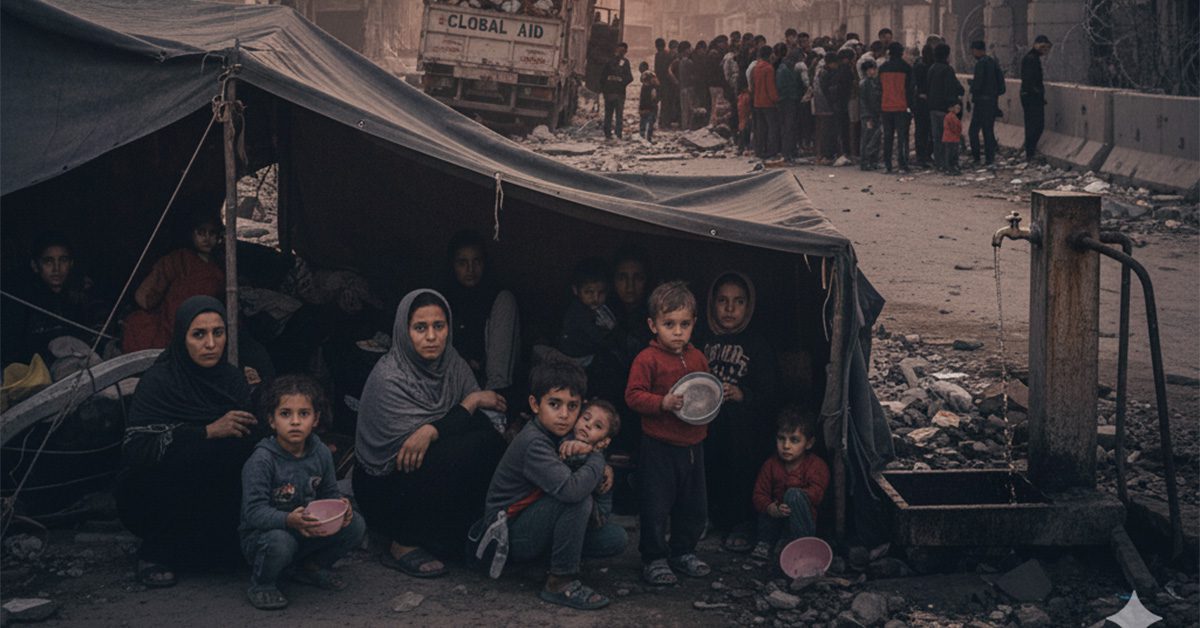
As the Gaza crisis November 2025 unfolds, the humanitarian situation in the besieged Palestinian territory has reached a breaking point. After months of relentless conflict and restricted access to essential supplies, millions of residents in Gaza are struggling to survive under dire conditions. International aid organizations are sounding the alarm, warning that Gaza’s civilian population faces an unprecedented catastrophe if immediate humanitarian relief is not allowed to enter.
The Israel conflict update reveals persistent hostilities, restricted border access, and a continuing blockade that has severely disrupted daily life. Meanwhile, the global community’s calls for ceasefire and aid access have intensified, as the crisis exposes the deep fractures in Middle Eastern diplomacy and international humanitarian response.
The Current Situation in Gaza
The Gaza Strip remains one of the most densely populated areas in the world, with over two million residents confined within just 365 square kilometers. In November 2025, the enclave faces shortages of clean water, electricity, fuel, and medical supplies due to the ongoing Gaza blockade.
Hospitals are operating under extreme conditions, with medical professionals reporting shortages of life-saving medicines, surgical equipment, and blood supplies. Doctors Without Borders and the Red Crescent have described the situation as “beyond critical,” emphasizing that patients are dying from treatable conditions simply because hospitals have run out of basic resources.
Electricity blackouts lasting up to 20 hours a day have forced families to rely on candles or makeshift generators, leading to accidents and fires. With winter approaching, displaced families are facing harsh living conditions in overcrowded shelters and temporary camps.
The Impact of the Blockade on Daily Life
The Gaza blockade, in place for more than a decade, has long limited the movement of goods and people. However, the current escalation has tightened restrictions further. Israel continues to justify the blockade as a security measure, citing the need to prevent the smuggling of weapons into Gaza.
For the people of Gaza, though, the blockade has become a symbol of collective punishment. Food prices have skyrocketed, unemployment rates are among the highest in the world, and nearly 80% of the population now depends on humanitarian assistance.
Children, who make up almost half of Gaza’s population, are suffering the most. Aid agencies have reported rising cases of malnutrition and psychological trauma among children who have witnessed airstrikes and displacement firsthand. Schools are either destroyed, turned into shelters, or operating with limited resources, further jeopardizing the future of an entire generation.
Palestine Aid Efforts Under Pressure
Despite the difficult circumstances, international organizations continue to provide Palestine aid to alleviate suffering. The United Nations Relief and Works Agency (UNRWA), the World Food Programme (WFP), and several NGOs have been coordinating food distribution, medical supplies, and emergency shelters.
However, aid groups are facing mounting challenges. With border crossings frequently closed and communication lines disrupted, delivering assistance has become a logistical nightmare. Many convoys have been delayed or denied entry due to ongoing hostilities or bureaucratic restrictions imposed by Israeli authorities.
Humanitarian leaders have repeatedly called for the establishment of “humanitarian corridors” to allow safe passage of essential supplies. The UN Secretary-General, in his recent address, emphasized that “aid should never be used as a weapon,” urging all parties to prioritize human life over political objectives.
Several Arab and Muslim-majority countries, including Qatar, Egypt, and Turkey, have pledged emergency relief packages. Yet, the scale of the crisis demands far greater international coordination and accountability to ensure that aid reaches those who need it most.
Israel Conflict Update: Growing Tensions and Global Response
According to the Israel conflict update, November 2025 has witnessed intensified military operations around Gaza’s borders. Sporadic airstrikes, cross-border rocket fire, and ground incursions have fueled fears of a prolonged conflict. The Israeli Defense Forces (IDF) maintain that their operations target militant infrastructure, while Palestinian factions argue they are defending their people against occupation and aggression.
The international response has been mixed. Western nations, including the United States and several European allies, have urged restraint while continuing to affirm Israel’s right to self-defense. Meanwhile, human rights organizations accuse both sides of violating international humanitarian law, citing indiscriminate attacks and civilian casualties.
At the United Nations, debates over ceasefire resolutions have once again highlighted global divisions. Several member states, including Russia, China, and South Africa, have condemned the blockade and demanded immediate humanitarian access. The United States, however, has used its veto power in the Security Council to block resolutions perceived as one-sided against Israel.
This diplomatic stalemate has left millions in Gaza with little hope for immediate relief. The Gaza crisis November 2025 has therefore become not just a humanitarian emergency but also a moral test for the global community’s commitment to justice and human rights.
Voices from the Ground: Stories of Survival
Behind the headlines and political rhetoric are the stories of ordinary Gazans struggling to survive.
- Amina, a mother of three from northern Gaza, describes how her family survives on one meal a day. “We cook with wood because there’s no gas, and my children haven’t had milk for weeks,” she says.
- Dr. Samir, a physician at Shifa Hospital, reports treating dozens of wounded patients daily with limited supplies. “We perform surgeries with minimal anesthesia. The world must not look away,” he pleads.
- Ahmed, a young student displaced from Rafah, dreams of returning to school. “I used to love math. Now I only think about when the next bombing will happen,” he shares.
These voices reflect the resilience of Gaza’s people amid unimaginable hardship, yet they also underscore the urgent need for a political solution that addresses the root causes of their suffering.
International Pressure and the Call for Ceasefire
The global outcry over the worsening Gaza crisis in November 2025 has intensified. Human rights groups, celebrities, and social activists have taken to social media platforms, using hashtags like #StandWithGaza, #EndTheBlockade, and #HumanityFirst to raise awareness.
The European Union has warned of potential sanctions and has called for an independent investigation into alleged war crimes committed during the conflict. Meanwhile, the Organization of Islamic Cooperation (OIC) has convened emergency meetings to coordinate a unified response and demand accountability.
Pressure is mounting on Israel to ease the blockade and allow humanitarian supplies to flow freely. However, progress remains slow as political leaders continue to prioritize security narratives over human rights imperatives.
The Path Forward: Toward Peace and Reconstruction
Ending the humanitarian catastrophe in Gaza requires more than temporary ceasefires or symbolic aid packages. Long-term peace and stability will only be achieved through genuine political dialogue and accountability.
- Lifting the Blockade: Allowing unrestricted access to food, medicine, fuel, and construction materials is essential for Gaza’s recovery.
- Reconstruction and Development: International donors must commit to rebuilding Gaza’s infrastructure—schools, hospitals, water systems, and housing.
- Accountability and Justice: Investigations into human rights violations must be transparent and impartial to ensure that victims receive justice.
- Reviving Peace Talks: A sustainable peace process between Israel and Palestine remains the only path to lasting stability in the region.
Without addressing these fundamental issues, the cycle of violence and suffering will only continue.
Conclusion: A Test of Humanity
The Gaza crisis in November 2025 stands as a stark reminder of the world’s collective failure to prevent humanitarian tragedy. As the blockade tightens and aid deliveries falter, millions of Palestinians remain trapped between conflict and despair.
The international community faces a moral obligation to act—not through rhetoric, but through concrete measures that prioritize human life and dignity. The voices from Gaza echo across the globe, calling for compassion, justice, and peace.
Only through global solidarity, sustained diplomacy, and an unwavering commitment to humanitarian principles can the people of Gaza hope to see an end to their suffering.
Read the latest news around the globe at supernews.pk