


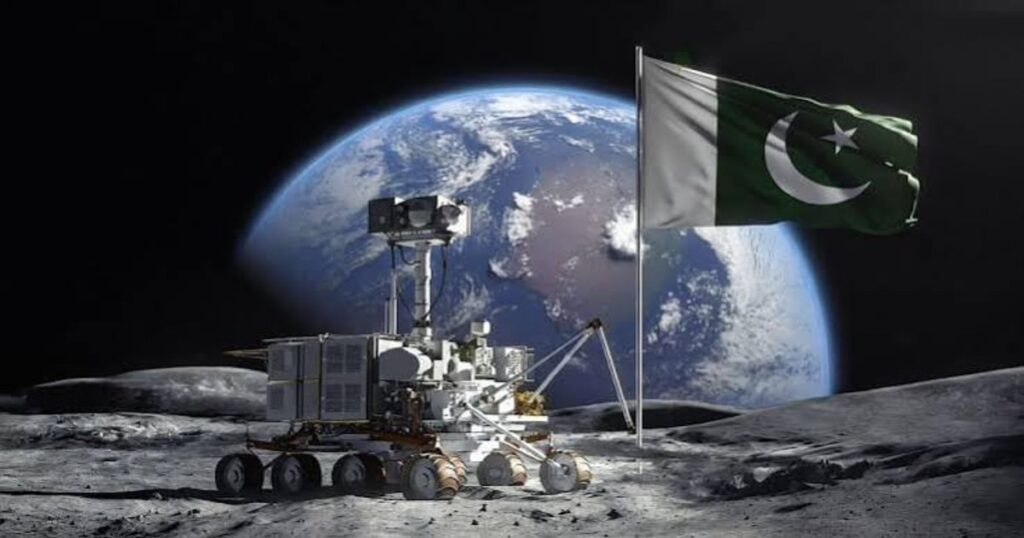
Pakistan has set an ambitious target of landing a spacecraft on the Moon by 2035 as it seeks to expand its space programme through cooperation with China. Planning Minister Ahsan Iqbal announced the goal while addressing the concluding ceremony of World Space Week 2026 in Narowal, Punjab, on October 18.
The announcement marks another step in Pakistan’s efforts to strengthen its space research capabilities, develop advanced technology and increase participation in international space missions.
Pakistan’s First Astronaut Mission Planned for November
Ahsan Iqbal said Pakistan’s first astronaut was scheduled to embark on a space mission from a Chinese space centre on November 25, 2026. The mission is part of the growing partnership between Pakistan and China in space exploration and scientific research.
The planned flight is expected to provide Pakistan with an opportunity to participate in human spaceflight through China’s space infrastructure. The announcement does not mean Pakistan will independently launch a crewed spacecraft; the mission relies on cooperation with China.
China Partnership Supports Lunar Exploration Plans
China is expected to play a major role in Pakistan’s long-term space ambitions. The two countries have already collaborated on satellite launches and space technology, helping Pakistan expand its Earth-observation and communications capabilities.
Pakistan is also developing a lunar rover intended to participate in China’s Chang’e-8 mission, planned for around 2028. The project could help Pakistani scientists and engineers gain experience in lunar exploration technologies. However, the planned rover mission is separate from the country’s stated 2035 Moon-landing target.
Pakistan Plans First Space Museum at University of Narowal
Alongside the lunar ambitions, the government has announced plans to establish Pakistan’s first Space Museum at the University of Narowal.
The proposed museum aims to raise awareness about astronomy, space science and modern technology, particularly among young people. The initiative was announced during World Space Week, which was organised in Narowal in collaboration with the Space and Upper Atmosphere Research Commission (SUPARCO).
The government has also highlighted the importance of expanding scientific education and encouraging students to pursue careers in research, engineering and emerging technologies.
Space Technology Could Benefit Key Sectors
Pakistan’s space programme has applications beyond lunar exploration. Satellite technology supports several important sectors, including:
-
Agriculture: Monitoring crops, land use and changing environmental conditions.
-
Climate monitoring: Tracking weather patterns and supporting disaster preparedness.
-
Communications: Strengthening satellite-based connectivity.
-
Education and research: Creating opportunities for students and scientists to develop technical expertise.
-
National security: Supporting satellite-based monitoring and related capabilities.
Planning Minister Ahsan Iqbal has stressed that investment in scientific research and space exploration is important for the country’s technological development.
Read more similar new in our technology category.
Can Pakistan Achieve Its 2035 Moon-Landing Target?
The 2035 target represents a long-term ambition rather than a confirmed landing schedule. Achieving it will require sustained funding, technical development, scientific expertise and continued international cooperation.
Partnerships with China could help Pakistan access technologies and experience that would otherwise take considerable time to develop independently. At the same time, progress will depend on how effectively the country builds its own research and engineering capabilities.
For now, the planned astronaut mission, lunar rover collaboration and proposed Space Museum represent separate initiatives within Pakistan’s broader effort to expand its presence in space science.
If you want to read more news like this visit supernews.pk