


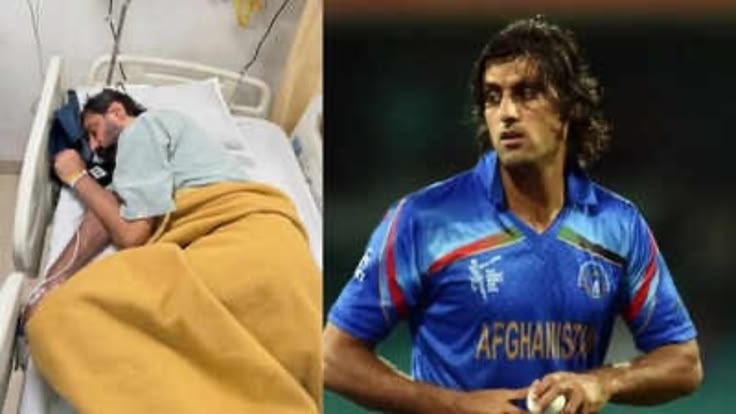
The death of Shapoor Zadran, one of Afghanistan’s most important fast bowlers, has shocked the cricket community. After a protracted struggle with a rare immunological condition, the former left-arm bowler passed away at the age of 38, leaving a lasting legacy that contributed to Afghanistan’s rise to prominence in international cricket.
Zadran spent the last several months receiving medical treatment in India after doctors diagnosed him with Hemophagocytic Lymphohistiocytosis (HLH). This severe illness causes the body’s immune system to attack healthy tissues. Despite intensive care and determined efforts by medical teams, his condition worsened, and he died just one day before his 39th birthday.
Long before Afghanistan became a familiar name at ICC tournaments, Shapoor Zadran stood among the players who carried the country’s cricketing dreams onto the global stage.
Making his international debut in 2009, the towering left-arm fast bowler represented Afghanistan in 44 One-Day Internationals and 36 Twenty20 Internationals over an 11-year career. His aggressive pace, distinctive run-up, and fearless attitude made him one of Afghanistan’s most recognizable cricketers during the team’s remarkable rise through international cricket.
The Afghanistan Cricket Board described him as one of the foundation stones of Afghan cricket, praising his passion, dedication, and commitment to helping establish the national team on the world stage.
Among countless memories, one stands above the rest.
During the 2015 ICC Cricket World Cup, Afghanistan secured its first-ever World Cup victory by defeating Scotland in a thrilling finish. Fittingly, it was Zadran who struck the winning boundary, creating one of the defining moments in the country’s sporting history.
That unforgettable victory symbolized far more than two points in a tournament. It showed that a nation with limited resources but immense determination could compete with established cricket powers. For many Afghan fans, Zadran became one of the faces of that momentous breakthrough.
Statistics can never tell the whole story of a player’s impact, but Zadran’s career is still an impressive one.
He claimed 43 ODI wickets and 37 T20I wickets, regularly troubling batters with bounce and movement. More importantly, he inspired an entire generation of young Afghan fast bowlers who followed his path into international cricket.
His performances arrived during an era when Afghanistan was still fighting for recognition in world cricket. Every victory, every wicket, and every milestone carried significance far beyond the scoreboard.
Tributes have started flooding in from throughout the cricket world after the death of Shapoor Zadran was announced.
He was honoured by the Afghanistan Cricket Board as a player who helped create the country’s cricketing identity with his grit and dedication. Fans also recalled his passionate celebrations, battling attitude and his strong joy at defending Afghanistan.
Across social media, former teammates, journalists, and supporters reflected on how Zadran inspired hope during the early years of Afghanistan’s international journey. Many recalled the famous World Cup win over Scotland as the image that will forever define his career.
The Shapoor Zadran death represents more than the loss of a former international cricketer. It celebrates the loss of one of the athletes who helped shift worldwide attitudes about Afghan sport.
His career proved that talent, resilience, and belief could overcome enormous obstacles. Young Afghan players now competing on the international stage continue to benefit from the foundation laid by pioneers like Zadran.
While future generations will remember his wickets and memorable victories, they will also remember the determination with which he represented his country during one of the most important periods in its cricketing history.
Cricket often celebrates records and trophies, but some players leave a deeper impact through the doors they open for others. Shapoor Zadran belongs in that category. His significance cannot be evaluated solely by wickets or matches played. He helped give Afghanistan confidence that it belonged among cricket’s elite, and that achievement will remain part of his legacy long after the scorecards fade.