


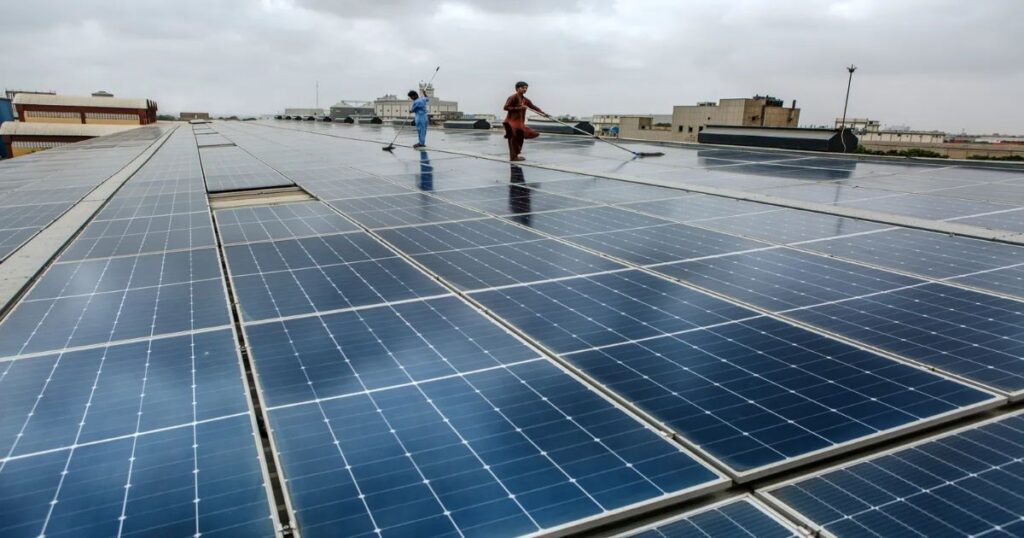
KARACHI, October 2, 2026 — Pakistan’s rapid shift toward solar power is reshaping the country’s electricity market while creating a difficult energy transition challenge for China, whose companies and banks have invested heavily in coal-fired power projects in Pakistan.
Solar Power Expands Rapidly Across Pakistan
Businesses, factories, farms and households across Pakistan are increasingly installing solar panels to reduce their reliance on expensive grid electricity. Solar accounted for around 20% of Pakistan’s electricity generation in 2025, compared with roughly 3% at the beginning of the decade, according to data cited by Bloomberg from energy think tank Ember.
High electricity tariffs, unreliable grid supply and falling prices for Chinese-made solar equipment have helped accelerate the trend. At industrial sites near Port Qasim, solar installations have become increasingly common as companies look for ways to reduce energy costs.
For some businesses, the savings have been substantial, with solar-generated electricity costing considerably less than electricity purchased from the national grid.
Chinese Coal Projects Face Falling Grid Demand
The rapid growth of distributed solar is reducing demand for conventional grid electricity, putting additional financial pressure on Pakistan’s already strained power sector.
Electricity consumption across Pakistan’s distribution companies was almost 12% lower in the 12 months to July 2025 than three years earlier, according to data cited in the Bloomberg report.
The development presents a particular challenge for Chinese-backed coal power plants. China has financed and built several major coal-fired facilities in Pakistan under its Belt and Road cooperation, with seven plants delivered since 2017 at a reported cost of about $9.6 billion.
Pakistan Owes Billions to Chinese Power Projects
The declining demand for grid electricity has also contributed to payment difficulties within Pakistan’s power sector.
According to officials cited by Bloomberg, overdue payments owed to Chinese electricity plants had exceeded $1.5 billion by August. Separately, outstanding project debt linked to China-financed coal power assets stood at about $3.1 billion last year.
The situation adds to Pakistan’s long-running circular debt problem, in which unpaid bills move through electricity distributors, generators and fuel suppliers.
Pakistan’s Energy Minister Awais Leghari has said Islamabad is seeking to extend the repayment period for power-sector debt rather than asking China to reduce the amounts owed.
Read more similar news in our local category.
China Faces a New Energy Transition Dilemma
The situation highlights an unusual conflict in China’s overseas energy strategy. Chinese companies have become major suppliers of solar panels, batteries and other clean-energy technologies, while Chinese state-owned companies also have major investments in conventional power plants.
Battery imports from China increased sharply in Pakistan during the first half of 2026, reaching about $392 million, according to customs data cited by Bloomberg.
Chinese officials are reportedly considering possible solutions, including restructuring debt, refinancing projects or finding ways to repurpose underused fossil-fuel facilities. Early retirement of some coal plants has also been discussed, although such proposals face financial and contractual challenges.
China’s Foreign Ministry told Bloomberg that energy cooperation with Pakistan has supported domestic energy supplies, helped lower electricity prices and contributed to economic development.
The developments in Pakistan could also provide an example of challenges China may encounter in other countries where its earlier coal investments increasingly compete with rapidly expanding renewable energy.
if you want to read more news like this visit supernews.pk