


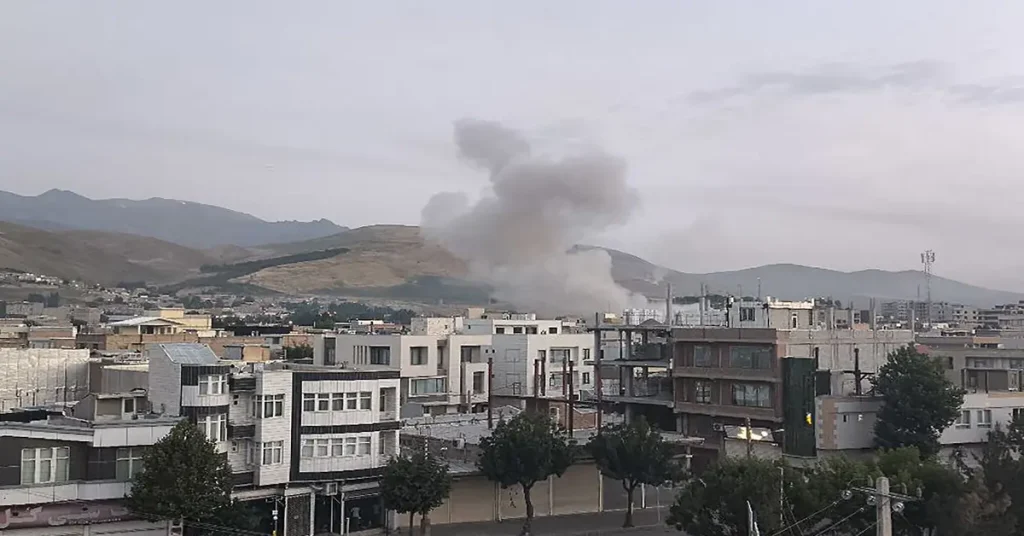
Israel strikes Iran nuclear facilities in a dramatic and dangerous escalation that has sent shockwaves across the Middle East and beyond. In the early hours of Friday, Israeli warplanes launched a sweeping offensive on Iran’s nuclear infrastructure, missile factories, and military leadership in what Prime Minister Benjamin Netanyahu called a “decisive moment in Israel’s history.”
Plumes of black smoke rose over Tehran as fire crews scrambled to rescue civilians trapped beneath rubble. Iran’s capital was rocked by powerful explosions, some near Natanz — the nation’s primary uranium enrichment facility. Amid the chaos, Iran vowed revenge, and the world braced for what might come next.
Missiles, Mayhem, and a Message
According to Israeli officials, Israel strikes Iran nuclear facilities to dismantle what it views as an imminent threat. “This is Operation Rising Lion,” Netanyahu declared in a grim video message. “We will not let Iran cross the nuclear threshold.”
The offensive, which Israel says is only the beginning of a prolonged campaign, targeted dozens of nuclear and military installations. The Natanz site was struck, reportedly damaging several sections of the facility, though Iran insists radiation levels remain unchanged.
Iranian state media confirmed that six nuclear scientists were killed in the assault. Among them: Mohammad Mehdi Tehranchi, president of Islamic Azad University, and Fereydoun Abbasi, a former head of the Atomic Energy Organization. Civilian casualties were also reported, including children caught in a strike on a residential block in Tehran.
A Top Commander Falls, and Retaliation Begins
In a stunning development, Iran’s elite Revolutionary Guard Corps announced that Hossein Salami, one of its most senior commanders, was killed in the strikes. Tehran responded by launching over 100 drones toward Israel, prompting emergency alerts across the country.
However, Israel’s military claimed it intercepted several UAVs before they could reach its borders. “We are prepared across all fronts,” said Israeli Chief of Staff Eyal Zamir. Tens of thousands of Israeli troops have now been deployed, with air defense systems on high alert.
Still, Israel strikes Iran nuclear facilities has drawn fierce condemnation and raised alarm bells in capitals across the globe.
Global Shockwaves and Rising Tensions
The United States swiftly distanced itself from the operation. “We were not involved in the strikes against Iran,” stated Secretary of State Marco Rubio. But Iranian officials accused Washington of complicity, warning both Israel and the U.S. of a “heavy price.”
Meanwhile, airspace across the Middle East began to shut down. Iraq, Iran, and Syria closed their skies. Emirates, Lufthansa, and Qatar Airways all suspended flights, and Dubai’s international airports issued travel warnings.
The UN’s nuclear watchdog, the IAEA, confirmed the Natanz facility was among the targets but reported no radiation spikes. Director Rafael Grossi expressed deep concern, warning, “Nuclear sites must never be a battlefield.”
Fallout in the Region: Jordan and Pakistan Respond
Neighboring Jordan found itself unwillingly drawn into the conflict, intercepting missiles and drones that strayed into its airspace. Sirens wailed in Amman, and citizens were urged to stay indoors. “Jordan will not be turned into a battleground,” declared government spokesperson Mohammad Momani.
Pakistan’s Prime Minister Shehbaz Sharif also issued a sharp rebuke, calling the assault “unprovoked and deeply irresponsible.” The Pakistani parliament passed a resolution condemning the attack, while the Foreign Office launched a crisis unit to assist nationals in Iran.
Escalation on the Eve of Diplomacy
Ironically, the strike came just days before scheduled nuclear talks between Iran and the U.S. in Oman. Despite the chaos, American officials confirmed the meeting was still set to proceed. “Diplomacy must continue,” a U.S. official said, though hopes for progress now appear dim.
Israel’s justification? Fresh intelligence suggesting Iran is “approaching the point of no return” in its nuclear weapons development. Though the U.S. maintains Iran hasn’t restarted its weapons program, Israel believes otherwise — and has chosen to act.
The Road Ahead
As the dust settles — for now — the question looms: what comes next?
Israel strikes Iran nuclear facilities was not a limited skirmish. It was a calculated, high-stakes gamble with global implications. Oil prices have surged, stock markets are rattled, and fear of a broader regional war is very real.
Ayatollah Khamenei called the strike “a wicked and bloody crime,” promising a “bitter fate” for Israel. The world watches nervously, hoping diplomacy can still prevail — but preparing for the possibility that it won’t.
This is a developing story. Stay tuned for more updates on this unfolding crisis.
Read latest news on supernews.pk