


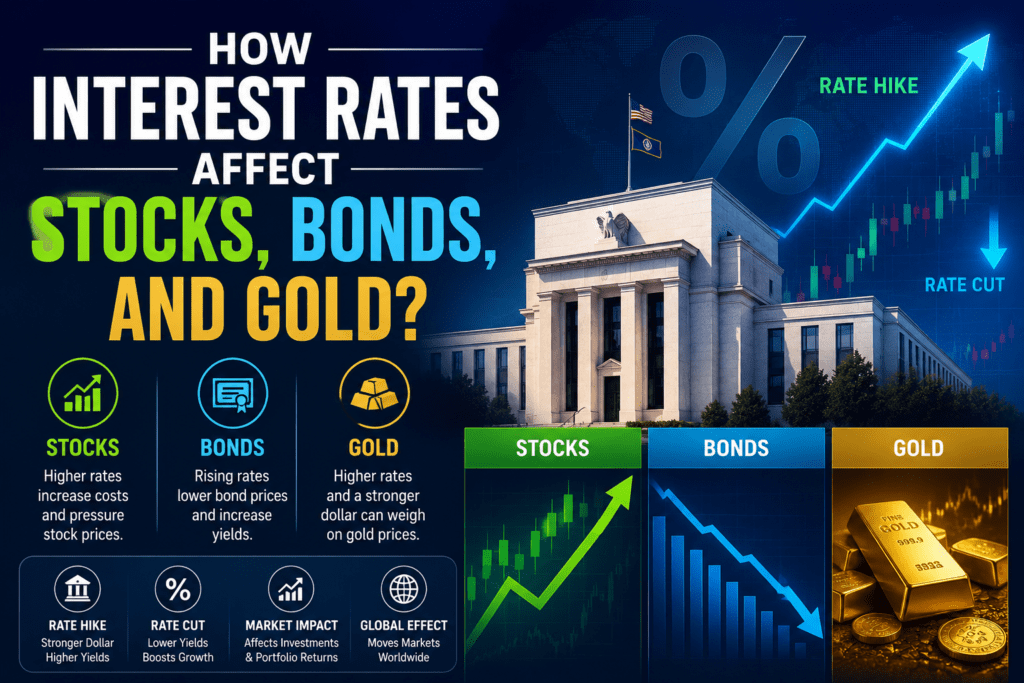
The Federal Reserve interest rates are among the most closely watched economic indicators in the world. Every time the U.S. Federal Reserve announces a rate decision, global financial markets react within minutes. Investors, businesses, governments, and consumers all pay close attention because changes in interest rates influence borrowing costs, inflation, investment returns, and overall economic growth.
While the Federal Reserve only sets monetary policy for the United States, its decisions often have a worldwide impact. Stock markets may rally or decline, bond prices can shift significantly, and gold prices frequently experience volatility following a rate announcement.
In this guide, we’ll explain how Federal Reserve interest rates impact stocks, bonds, and gold, why investors closely monitor Fed meetings, and what these decisions could mean for your investment portfolio.
What Are Federal Reserve Interest Rates?
Federal Reserve interest rates refer to the target range for the federal funds rate, which is the interest rate at which banks lend money to one another overnight. Although consumers do not borrow directly at this rate, it influences nearly every major interest rate in the economy, including:
- Mortgage rates
- Auto loans
- Business loans
- Credit cards
- Savings accounts
- Treasury yields
The Federal Reserve raises or lowers interest rates primarily to control inflation and maintain stable economic growth.
Why Does the Federal Reserve Change Interest Rates?
The Federal Reserve has two primary objectives:
- Maintain stable prices (control inflation)
- Promote maximum employment
When inflation rises too quickly, the Fed often increases interest rates to slow spending and borrowing. When the economy weakens, it may lower interest rates to encourage businesses and consumers to borrow, spend, and invest.
These policy decisions ripple across global financial markets, affecting nearly every asset class.
How Federal Reserve Interest Rates Affect Stocks
Stocks are one of the first markets to react after a Federal Reserve announcement.
When Interest Rates Increase
Higher interest rates generally create challenges for stock markets because:
- Companies face higher borrowing costs.
- Consumers spend less.
- Corporate profits may decline.
- Investors shift toward safer assets offering attractive yields.
Technology companies are often the most sensitive because many rely on future earnings. Higher interest rates reduce the present value of those future cash flows, leading to lower stock valuations.
When Interest Rates Decrease
Lower interest rates usually support stock prices because:
- Businesses can borrow at lower costs.
- Consumer spending increases.
- Companies expand operations.
- Corporate earnings often improve.
As a result, investors frequently become more willing to invest in equities during periods of lower interest rates.
Which Stock Sectors Benefit?
Higher Interest Rates
Sectors that may perform relatively well include:
- Banks
- Insurance companies
- Financial services
Banks can often earn more from lending when interest rates increase.
Lower Interest Rates
Industries that often benefit include:
- Technology
- Real estate
- Consumer discretionary
- Growth companies
These sectors typically rely on affordable financing and stronger consumer demand.
How Federal Reserve Interest Rates Affect Bonds
The relationship between interest rates and bonds is one of the most important concepts in investing.
Bond Prices and Interest Rates Move Oppositely
When interest rates rise:
- Existing bond prices usually fall.
- Newly issued bonds offer higher yields.
- Older bonds become less attractive.
When interest rates fall:
- Existing bond prices generally rise.
- Older bonds paying higher interest become more valuable.
Understanding this inverse relationship helps investors manage risk in fixed-income portfolios.
Why Bond Investors Watch the Fed
Bond investors pay close attention to Federal Reserve meetings because even small rate changes can significantly impact bond values.
Long-term bonds are generally more sensitive to interest rate changes than short-term bonds.
For example:
- A 30-year Treasury bond typically experiences larger price swings than a 2-year Treasury bond after a Fed decision.
Because of this, professional investors frequently adjust bond allocations based on expectations for future interest rate policy.
How Federal Reserve Interest Rates Affect Gold
Gold behaves differently from stocks and bonds because it does not produce income such as dividends or interest.
When Interest Rates Rise
Gold often faces downward pressure because:
- Investors can earn better returns from savings accounts and bonds.
- Holding non-interest-bearing assets becomes less attractive.
- A stronger U.S. dollar often weighs on gold prices.
When Interest Rates Fall
Lower interest rates frequently support gold prices because:
- Bond yields decline.
- The opportunity cost of holding gold decreases.
- Investors seek protection against inflation and currency weakness.
However, gold prices also depend on geopolitical risks, inflation expectations, central bank purchases, and investor sentiment.
Why the U.S. Dollar Matters
Federal Reserve interest rates strongly influence the U.S. dollar.
Higher interest rates generally strengthen the dollar because global investors seek higher returns from U.S. assets.
A stronger dollar often causes:
- Gold prices to weaken.
- Commodity prices to decline.
- Emerging market currencies to face pressure.
Lower interest rates can have the opposite effect, making the dollar less attractive and supporting commodity prices.
Real-World Example
Imagine the Federal Reserve raises interest rates by 0.25%.
Possible market reactions include:
Stocks
- Technology shares decline.
- Banking stocks may rise.
- Growth stocks experience increased volatility.
Bonds
- Treasury yields increase.
- Existing bond prices fall.
Gold
- Gold prices may decline if investors move toward higher-yielding assets.
Although markets do not always react exactly this way, these patterns have occurred frequently over past interest rate cycles.
Why Investors Closely Watch Federal Reserve Meetings
Every Federal Reserve meeting provides valuable clues about the future direction of monetary policy.
Investors pay attention to:
- Interest rate decisions
- Inflation forecasts
- Economic growth projections
- Employment outlook
- Federal Reserve Chair press conferences
Sometimes the Fed leaves interest rates unchanged, yet markets still experience significant volatility based on future guidance.
This is why professional investors analyze not only what the Fed does, but also what it signals for upcoming meetings.
How Interest Rates Affect Everyday Investors
Federal Reserve decisions impact more than just Wall Street.
Higher interest rates may result in:
- More expensive mortgages
- Higher credit card interest
- Increased business loan costs
- Better savings account returns
Lower interest rates often lead to:
- Cheaper home loans
- Easier business financing
- Increased stock market activity
- Lower returns on savings accounts
Understanding these relationships helps individuals make more informed financial decisions.
Investment Strategies During Different Interest Rate Environments
Although every investor has unique financial goals, some general approaches include:
During Rising Interest Rates
- Focus on financially strong companies.
- Consider shorter-duration bonds.
- Maintain portfolio diversification.
- Monitor inflation trends.
During Falling Interest Rates
- Growth stocks may perform better.
- Longer-duration bonds may appreciate.
- Real estate investments may benefit.
- Gold could gain if inflation expectations increase.
Diversification remains one of the most effective ways to manage uncertainty regardless of the interest rate environment.
Frequently Asked Questions
Do Federal Reserve interest rates affect global markets?
Yes. Because the U.S. dollar is the world’s primary reserve currency, Federal Reserve decisions influence global stock markets, bond markets, exchange rates, and commodity prices.
Why do stocks sometimes rise after a rate hike?
Markets often react to future expectations rather than current decisions. If investors believe inflation is improving or future rate increases will be limited, stocks may rally even after a rate hike.
Why is gold sensitive to interest rates?
Gold does not pay interest or dividends. When interest rates rise, investors often prefer assets that generate income, reducing demand for gold.
Are bonds safer during high-interest-rate periods?
While bonds are generally considered lower risk than stocks, rising interest rates can reduce the value of existing bonds. Investors should understand duration risk before investing.
Conclusion
Federal Reserve interest rates play a central role in shaping financial markets. Whether rates rise, fall, or remain unchanged, investors closely monitor every announcement because these decisions influence stocks, bonds, gold, currencies, and the broader economy.
Stocks often benefit from lower borrowing costs, bonds move inversely to interest rates, and gold tends to react to changes in real yields and the strength of the U.S. dollar. Understanding these relationships allows investors to better interpret market movements and make more informed long-term decisions.
Rather than reacting emotionally to every Federal Reserve announcement, successful investors focus on maintaining diversified portfolios, staying informed about economic trends, and aligning investment decisions with their financial goals.