


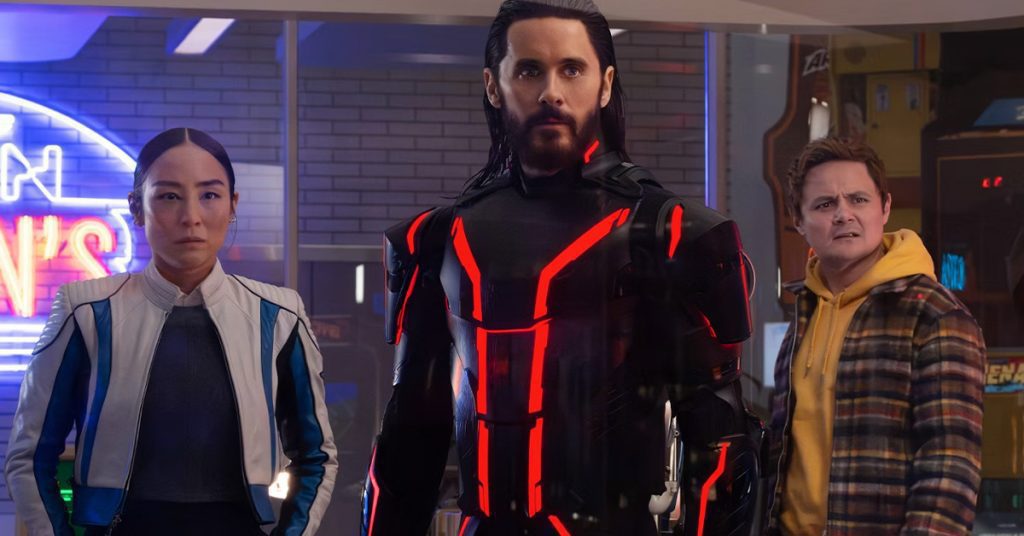
The Tron Ares movie review reveals that Disney’s once-revolutionary franchise has lost much of its spark. The original Tron thrilled audiences with futuristic visuals and iconic lightcycles, but Tron: Ares feels like a dim reflection of that legacy. Directed by Joachim Rønning, the third installment arrives in theaters on October 10 (rated PG-13) and earns just ★★ out of four — offering dazzling effects but little emotional depth.
In Tron Ares, Jared Leto stars as Ares, a malfunctioning digital warrior who longs to become human. The story pits two tech giants, ENCOM and Dillinger Systems, against each other in a race to control artificial intelligence. ENCOM’s CEO Eve Kim (Greta Lee) uses AI for creation, while her rival Julian Dillinger (Evan Peters) weaponizes it for destruction. When Eve unlocks a secret “Permanence Code” from former ENCOM head Kevin Flynn’s old computer, Ares is sent from the Grid to retrieve it — setting off a chain reaction that blurs the boundaries between the digital and real worlds.
The Tron Ares movie review notes that while the film toys with themes of AI and humanity, it never dives deep enough to make a lasting impact. Despite promising material, the script feels overloaded with exposition and light on meaning. The nostalgic return of Jeff Bridges as Flynn offers brief flashes of charm, but can’t save the film from its mechanical storytelling.
Visually, Tron: Ares delivers the signature neon glow and high-tech style the franchise is known for — from Ares’ glowing armor to fast-paced surf-speeders across the Grid. Yet, beneath the striking design lies a hollow narrative that struggles to keep viewers invested. The techno beats and Nine Inch Nails score are highlights, but the movie feels more like a music video than a meaningful sci-fi adventure.
As the Tron Ares movie review explains, the film’s core idea — an AI yearning to become human — could have been powerful. However, Leto’s performance swings unevenly between robotic and overwrought, while Lee and Peters are left with underdeveloped roles. Even Gillian Anderson, appearing briefly as Julian’s mother, is underused.
The film’s action scenes, though visually exciting, fail to offer much coherence. Viewers are left asking how lasers can turn humans into digital beings and why the story seems to care more about spectacle than science.
Like Tron: Legacy (2010), which had a phenomenal Daft Punk soundtrack, Tron: Ares once again proves better to listen to than to watch. Its Nine Inch Nails score energizes the experience, but the overall film lacks the innovation that made Tron a cult classic.
The Tron Ares movie review concludes that this sequel feels like a missed opportunity — a flashy but hollow journey that forgets the spirit of discovery that once defined the Grid.
Read latest news and updates on supernews.pk