


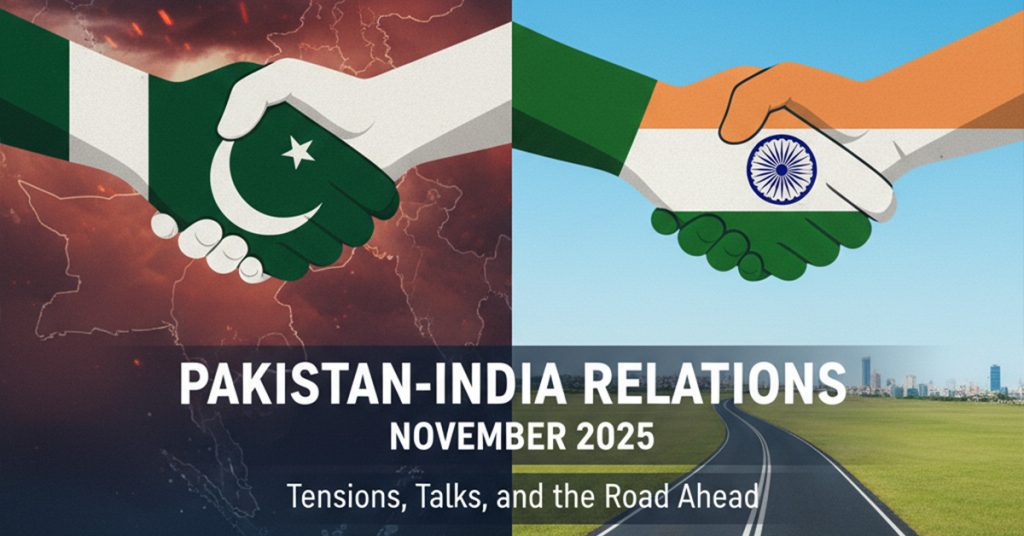
The relationship between Pakistan and India has always been one of the most complex geopolitical dynamics in South Asia. In November 2025, the state of Pakistan-India relations remains defined by unresolved territorial disputes, border security challenges, suspended dialogue processes, and cautious attempts at limited diplomatic engagement. For decades, the two nuclear-armed neighbors have navigated cycles of tension and reconciliation, with global powers and regional organizations often urging both sides to pursue de-escalation.
Today, the bilateral environment continues to be influenced by developments around the India-Pakistan border, the status of the Kashmir issue in 2025, evolving political narratives, and international pressure for peace. This pillar blog explores these dimensions in-depth, offering a comprehensive overview of the current situation, historical context, and potential future trajectory of the Indo-Pak talks.
Historical Context: A Relationship Built on Conflict and Cooperation
To understand Pakistan-India relations in November 2025, it is essential to revisit the roots of their rivalry. Since 1947, the two countries have fought multiple wars, mainly over Jammu and Kashmir. Despite brief periods of warmth—such as the Lahore Declaration (1999), the Musharraf-Vajpayee composite dialogue era, and the 2011-14 limited engagement—relations have generally remained tense.
Over the last decade, diplomatic interactions have significantly declined, particularly after events such as:
- The 2016 Uri attack and India’s subsequent “surgical strikes”
- The 2019 Pulwama incident and Balakot airstrikes
- India’s August 2019 revocation of Article 370, altering Kashmir’s special status
- Limited cooperation during the COVID-19 pandemic
- Repeated military incidents along the Line of Control (LoC)
These developments created deep mistrust that still shapes the narrative in Pakistan-India relations November 2025.
Current Border Situation: Persistent Tension Despite Ceasefire Pledges
The India-Pakistan border, including the LoC and the Working Boundary, remains one of the most militarized regions in the world. Although a ceasefire reaffirmation was announced in February 2021, periodic violations and accusations continue.
Key Factors Influencing Border Tensions in November 2025
- Military Build-Up on Both Sides
Both countries maintain heavy troop deployments along the border, with advanced surveillance systems, artillery positions, and fortified posts. Occasional flare-ups, though smaller than in previous years, still contribute to uncertainty. - Cross-Border Accusations
Pakistan accuses India of aggression along the LoC and supporting instability inside Pakistan. India, in turn, accuses Pakistan of infiltration attempts and militancy originating from Pakistani territory. - Lack of Joint Monitoring Mechanisms
Unlike previous CBMs (Confidence Building Measures), formal communication channels remain mostly inactive. This absence increases the risk of misinterpretation and rapid escalation. - Smuggling and Illegal Movement
Despite heightened security, the India-Pakistan border faces issues such as narcotics smuggling, human trafficking, and unauthorized civilian movement, creating additional challenges for border forces.
While November 2025 has not seen a major border crisis, the underlying tensions remain unresolved, contributing to the fragile nature of bilateral relations.
The Kashmir Issue 2025: Central to the Stalemate
The Kashmir issue in 2025 continues to be the most critical dispute between Pakistan and India. Despite decades of negotiations, UN resolutions, and international appeals, the situation in the region remains tense.
Pakistan’s Position
Pakistan maintains that:
- Kashmir is a disputed territory.
- The people of Kashmir have a right to self-determination.
- India’s revocation of Article 370 in 2019 was illegal and unilateral.
- Human rights violations must be internationally addressed.
Pakistan continues to demand restoration of the region’s special status and involvement of Kashmiri leadership in any future dialogue.
India’s Position
India insists that:
- Kashmir is an internal matter.
- Constitutional changes in 2019 were within India’s sovereign right.
- Talks with Pakistan can only begin after cross-border militancy ends.
India continues investing heavily in infrastructure development, demographic restructuring initiatives, and enhanced security presence in the region.
Ground Reality in 2025
Residents in Kashmir continue to experience:
- Strict security measures
- Communication restrictions during periods of unrest
- Concerns over demographic shifts
- Limited political autonomy
For both nations, Kashmir remains not only a territorial dispute but also a matter of national identity and security. Hence, the issue continues to block meaningful progress in Pakistan-India relations.
Diplomatic Landscape: Indo-Pak Talks Remain Stalled but Not Dead
Formal Indo-Pak talks are currently suspended. However, both countries occasionally engage in back-channel communication facilitated by friendly nations or intelligence agencies.
Why Talks Are Stalled
- Domestic Political Pressures
Leaders on both sides face strong nationalist sentiments. Any attempt to initiate dialogue is often criticized domestically. - Security Concerns
India demands an end to cross-border militancy first, while Pakistan wants dialogue without preconditions. - International Environment
Global powers have competing interests in South Asia. The geopolitical rivalry involving China and the U.S. affects regional diplomacy.
Signs of Limited Engagement in 2025
Despite the lack of formal talks, some cautious developments hint at a potential thaw:
- Back-channel intelligence-level communication
- Border commanders’ meetings to manage flare-ups
- Agreements on humanitarian issues such as prisoner exchanges
- Shared concerns on climate disasters, when both countries offered mutual flood information
- Occasional statements from leaders expressing willingness for “peaceful coexistence”
These signals indicate that the door to diplomacy is not fully closed—just temporarily jammed.
Trade Relations: Minimal but Not Entirely Absent
Trade between Pakistan and India remains extremely limited. While official trade is largely suspended, informal trade through the UAE or Afghanistan continues at low levels.
Why Trade Is Restricted
- Security concerns
- Restrictions on imports and exports
- Political tensions
- Public pressure in both countries
- Visa limitations for business travelers
However, economists believe that restoring trade could:
- Lower inflation
- Reduce production costs
- Improve regional supply chains
- Support peace-building
As of November 2025, there are periodic calls from business communities and international financial institutions urging both sides to consider reopening trade routes.
People-to-People Interaction: The Untapped Peace Catalyst
Despite political tension, the people of Pakistan and India often express deep cultural and emotional bonds.
Where Interaction Still Exists
- Online communities on social media
- Cross-border charity efforts
- Cultural events shared through digital platforms
- Poetry, music, and drama collaborations
- Cricket and sports diplomacy (informal, online discussions)
Barriers
- Strict visa regimes
- Limited academic exchange
- Media propaganda on both sides
Experts argue that enhancing people-to-people contact could soften political hostility over time.
Role of Global and Regional Powers
International actors such as the United States, China, the Gulf states, and the United Nations closely watch the evolving Pakistan-India dynamics.
United States
Focuses on nuclear security, trade stability, and preventing escalation.
China
Supports Pakistan but maintains economic ties with India.
Gulf Countries
Try to mediate limited communication between Islamabad and New Delhi.
United Nations
Continues calling for peaceful dialogue and conflict resolution, especially regarding Kashmir.
Global stakeholders generally encourage both countries to reduce hostilities for the sake of regional stability and economic growth.
Challenges Ahead for Pakistan-India Relations
- Lack of Trust
Decades of mistrust have created political rigidity and reluctance to negotiate. - Rise of Nationalism
Hardline narratives dominate public opinion in both countries. - No Structured Dialogue Mechanism
Without platforms like the Composite Dialogue Process, misunderstandings increase. - Security Challenges
Militancy, cyber warfare, and intelligence concerns continue to shape policy decisions. - Unresolved Core Issues
Kashmir remains the biggest roadblock to normalization.
Possible Pathways to Peace and Cooperation
Despite difficulties, several constructive options exist:
- Revival of Back-Channel Diplomacy
Quiet, informal discussions could pave the way for future official dialogue.
- Humanitarian Cooperation
Joint disaster response, health collaborations, and prisoner releases can help build trust.
- Controlled Trade Openings
Allowing certain goods across the border could boost economic stability.
- Confidence Building Measures
Reinstating cross-border bus services, sporting events, and cultural festivals.
- Third-Party Mediation
Though India opposes formal mediation, friendly nations can still facilitate communication informally.
Conclusion
Pakistan-India relations in November 2025 remain shaped by long-standing disputes, border tensions, and political challenges. While formal dialogue is stagnant, limited engagement continues through quiet channels, humanitarian gestures, and border-level communication.
The India-Pakistan border remains tense but manageable. The Kashmir issue in 2025 remains unresolved and central to the regional narrative. Despite these hurdles, there are cautious signs of potential movement toward diplomacy, provided both sides prioritize stability over confrontation.
Read latest news and updates at supernews.pk