


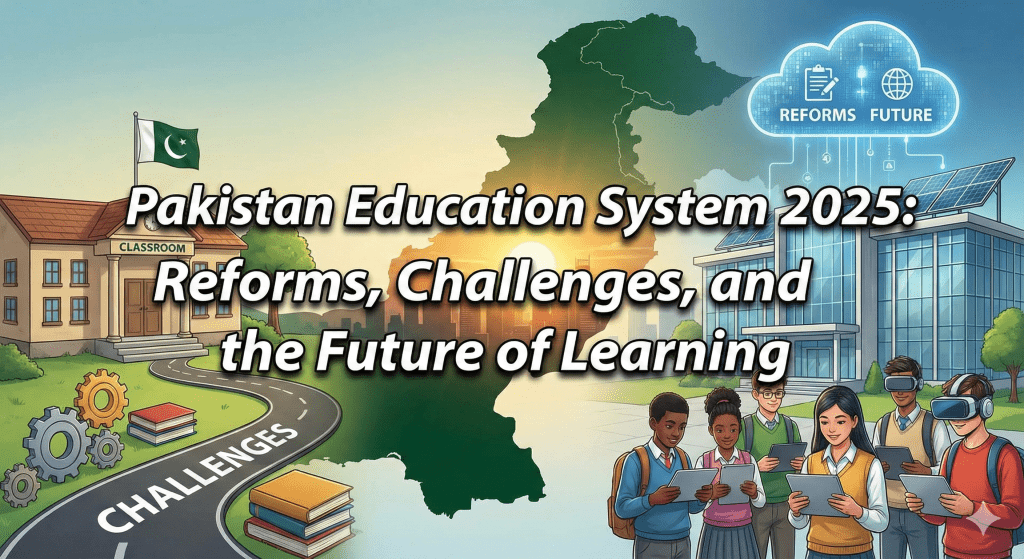
The Pakistan education system 2025 is undergoing an important transformation driven by technology, policy reforms, and the growing need to equip students with modern skills. As the world moves toward digital-first learning, Pakistan is stepping into a new era of education where access, quality, curriculum enhancement, and teacher training are the core priorities.
For decades, the education structure in the country has faced several challenges: outdated curricula, lack of training for teachers, inequality between private and public institutions, and limited access to digital resources. However, the developments expected by 2025—supported by both public and private stakeholders—signal meaningful change across schools in Pakistan, colleges, universities, and technical training institutions.
This comprehensive analysis explores how Pakistan’s education sector is evolving, the reforms underway, and how students, teachers, and institutions will be impacted by 2025.
Overview of Pakistan’s Education Landscape
Pakistan’s education ecosystem consists of public schools, private schools, madrassahs, colleges, and higher education institutions. Each operates under different funding models and governance structures. Currently, the national literacy rate stands at around 60 percent, with wide gaps between regions, genders, and socioeconomic classes.
As Pakistan prepares for 2025, the key objective is to create an education system that is more inclusive, transparent, and future-ready. Nationwide initiatives are focusing on:
- Curriculum modernization
- Digital transformation
- Investment in higher education Pakistan
- Teacher training and capacity building
- Quality assurance through regulatory mechanisms
The central aim is to develop a competitive workforce that can contribute to innovation, technology, and economic growth.
Pakistan Education System 2025: Key Drivers of Change
The future of Pakistan’s education system is shaped by several major forces:
- Digital Transformation
Technology is becoming a backbone of modern learning. The post-pandemic acceleration of e-learning has permanently changed classroom structures. By 2025:
- Smart classrooms will be more common in urban schools.
- Online learning platforms will be used for blended learning.
- Digital exams and AI-assisted grading are expected to increase.
- Students will have access to remote learning resources, especially in remote regions.
The government and private sector are investing in digital libraries, online training modules, and virtual learning environments to reduce educational inequalities.
- Education Reforms and Policy Updates
The government has introduced multiple education reforms focusing on standardizing learning outcomes, improving teacher recruitment, and updating the curriculum to meet modern requirements.
Reforms for 2025 include:
- Revised national curriculum
- Focus on STEM subjects
- Increased budget allocation for education
- Partnerships with international bodies for teacher development and university accreditation
- New quality benchmarks for private schools
These reforms aim to minimize the gap between private and public education standards.
- Rise of Skill-Based Learning
The traditional rote-learning model is gradually being replaced with skill-based education. Pakistan’s youth population is one of the largest in the world, and the job market is demanding new capabilities such as:
- Digital literacy
- Critical thinking
- Communication and leadership
- Entrepreneurship
- Technical and vocational skills
By 2025, TVET (Technical and Vocational Education and Training) programs will play a bigger role in shaping employability.
- Public-Private Partnerships
Private organizations and NGOs are significantly contributing to improving schools in Pakistan and higher education institutes. These collaborations will expand further by 2025 to include:
- Infrastructure development
- Teacher training initiatives
- Technology integration projects
- Scholarship and funding programs for low-income students
Schools in Pakistan: The Shift Toward Modern Learning
The condition of schools in Pakistan varies significantly across provinces. Urban schools have better facilities, while rural areas face severe shortages of teachers, infrastructure, and digital resources.
- Public Schools
Public schools are at the center of reform efforts. By 2025, major improvements are expected in:
- Infrastructure (classrooms, electricity, sanitation)
- Digital access (internet, tablets, computer labs)
- Teacher competency standards
- Updated textbooks aligned with the Single National Curriculum (SNC)
The introduction of digital content aims to make learning more interactive and engaging.
- Private Schools
Private schools are rapidly adopting modern teaching styles and technology-driven tools. These institutions are incorporating:
- Foreign curricula
- Hybrid learning models
- Robotics and coding classes
- Language development programs
- 21st-century skills training
By 2025, private schools will play a pivotal role in shaping technology-enabled learning environments.
- Madrassah Education
Madrassahs are essential components of Pakistan’s education landscape. The government aims to bring them under a unified framework by integrating modern subjects such as mathematics, science, and English. These steps are crucial to ensuring equal opportunities for madrassah students.
Higher Education Pakistan: Universities and Research in 2025
The higher education Pakistan sector is making progress with new policies, increased funding, and a greater focus on research. Universities are shifting toward innovation, technology, and academic excellence.
Key Trends for 2025 in Higher Education:
- Expansion of Digital Universities
Virtual universities and online degree programs are gaining popularity. By 2025, remote learning will be more structured, regulated, and recognized globally.
- Research and Development Boost
Pakistan is investing more in scientific research, particularly in:
- Artificial intelligence
- Biotechnology
- Engineering
- Renewable energy
- Climate science
Universities are establishing partnerships with international institutions to encourage collaborative research.
- Industry-Academia Collaboration
To bridge the gap between education and employment, universities are aligning curricula with industry requirements. This alignment enhances job opportunities for graduates.
- Scholarships and International Programs
Scholarships funded by the government, foreign agencies, and private organizations are increasing access to higher education. Exchange programs and dual-degree initiatives will be more common by 2025.
Education Reforms Expected by 2025
Education reforms are integral to the country’s development. Key policy reforms shaping the Pakistan education system 2025 include:
- Single National Curriculum (SNC) Implementation
The SNC aims to reduce inequality by standardizing educational content nationwide. By 2025, the curriculum will further evolve with:
- Multigrade teaching strategies
- Digital learning resources
- Revised assessment models
- Improved teacher guidelines
- Teacher Certification and Training
Teacher training is one of Pakistan’s biggest educational challenges. New reforms require:
- Standardized teacher certification
- Digital competency training
- Continuous professional development (CPD)
- Evaluation based on performance and skill growth
- Examination Reforms
The exam system is shifting toward conceptual learning instead of rote memorization. Expected changes include:
- Project-based assessments
- Digital testing centers
- Higher-order thinking skill evaluations
- Increased Budget Allocation
The government plans to gradually increase the education budget to improve infrastructure, provide scholarships, and support digital transformation.
Challenges Facing the Pakistan Education System 2025
Despite progress, several challenges continue to impact the education sector.
- Inequality Between Urban and Rural Areas
Urban regions receive higher investment and better facilities. Rural students face barriers such as:
- Limited infrastructure
- Fewer qualified teachers
- Poor internet access
- High dropout rates
- Outdated Teaching Methods
Many instructors still rely on lecture-based teaching. The transition to modern methods requires investments in training and technology.
- Economic Constraints
Budget limitations affect school development, teacher salaries, and the maintenance of educational institutions.
- Governance and Management Issues
Bureaucratic processes and inconsistent policies create inefficiencies across educational institutions.
- Limited Focus on Special Education
Special needs students require more attention, specialized staff, and better facilities.
Opportunities for Growth in the Education Sector
While challenges persist, the Pakistan education system 2025 presents significant opportunities:
- EdTech Expansion
The rise of educational technology startups is transforming how students learn. E-learning platforms, mobile apps, and AI tools are creating accessible and affordable educational solutions.
- Increased International Collaboration
Global partnerships with universities in Europe, China, the Middle East, and the United States will enhance academic standards.
- Emphasis on STEM
STEM programs will strengthen Pakistan’s competitiveness and support economic growth.
- Focus on Female Education
More initiatives are promoting girls’ education through stipends, community outreach, and improved safety.
The Future of Learning in Pakistan by 2025
By 2025, Pakistan’s education system is expected to move significantly closer to a modern, digital, and inclusive model. Key outcomes likely include:
- Higher literacy rates
- Expanded digital access across public and private schools
- Greater use of technology in learning
- Skilled graduates ready for global employment
- Improved research output from universities
If reforms are implemented consistently, Pakistan will be positioned to compete globally in science, technology, and innovation.
Conclusion
The Pakistan education system 2025 represents both a major challenge and a historic opportunity. With technological advancements, progressive reforms, and increased investment in schools and universities, the country is moving toward a more inclusive and forward-looking education model.
Though inequalities and management issues persist, the future is hopeful. The transformation of schools in Pakistan, the modernization of higher education Pakistan, and sustained education reforms will define the next decade of learning. Ultimately, the progress made by 2025 will shape the productivity, creativity, and competitiveness of Pakistan’s next generation.