


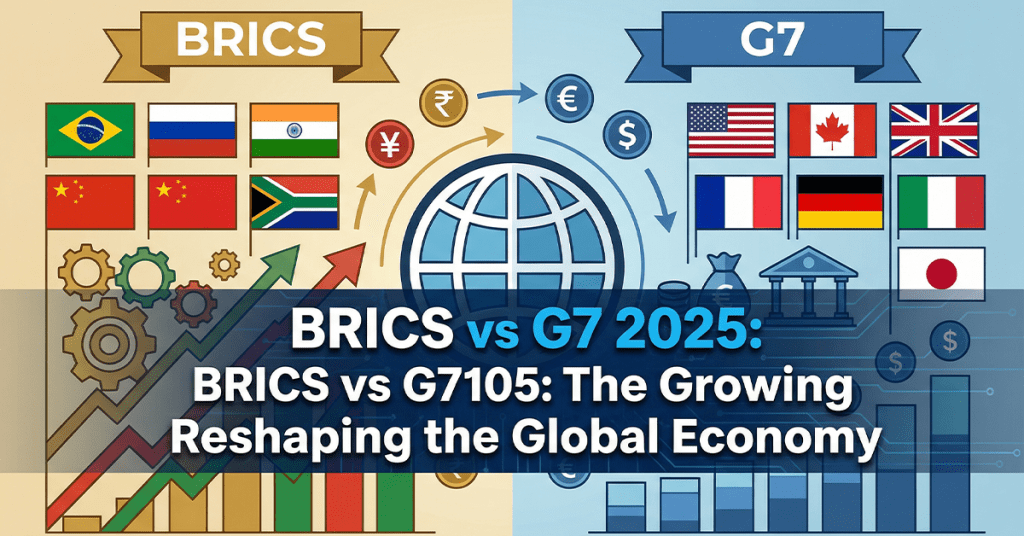
The rivalry between BRICS and G7 has become one of the most defining geopolitical and economic debates of our time. As we move deeper into 2025, global analysts, policymakers, and investors are closely watching how these two blocs compete for influence, control, and leadership. The debate around BRICS vs G7 2025 is not just a comparison of economic strength—it is a window into a rapidly changing global system, where emerging markets challenge decades of Western dominance.
This power struggle is reshaping the global economy 2025, shifting alliances, transforming trade patterns, and altering the strategic landscape of world politics. From technology and currency reform to infrastructure dominance and energy control, almost every aspect of global governance is evolving. As nations reconsider their economic priorities, many developing countries now turn to BRICS for opportunities, while Western nations rely on G7 to maintain economic stability and democratic values.
In this detailed 2000-word analysis, we break down how BRICS and G7 compare, where their rivalry is headed, and what the future global order may look like. We also provide an internal reference for readers seeking more updates through International News on SuperNews.pk.
What is the G7? An Overview of the Western Economic Bloc
The G7, or Group of Seven, is a coalition of the world’s most advanced industrial economies:
- United States
- United Kingdom
- Canada
- Germany
- France
- Italy
- Japan
For decades, the G7 has played a crucial role in leading global economic policies, financial stability, climate strategies, and crisis management. With strong democratic foundations, technological leadership, and major control over the International Monetary Fund (IMF) and World Bank, the G7 has shaped world policies since the late 20th century.
However, their dominance is slowly decreasing. Economic stagnation, aging populations, rising debt levels, and the rapid expansion of emerging markets have introduced new competitors—most notably BRICS.
What is BRICS? The Emerging Power Bloc Challenging the West
BRICS originally stood for Brazil, Russia, India, China, and South Africa. But by 2024–2025, BRICS expanded significantly, welcoming:
- Saudi Arabia
- UAE
- Iran
- Egypt
- Ethiopia
This expansion pushed BRICS into a new era. It is no longer just a group of fast-growing economies—it is a global powerhouse representing energy giants, population hubs, digital markets, and manufacturing centers.
BRICS now accounts for:
- Nearly 45% of the global population
- Over 30% of world GDP (PPP)
- Almost 40–42% of global energy output
The expansion has positioned BRICS as the most serious rival the G7 has ever faced.
BRICS vs G7 2025: A Battle for Global Economic Leadership
- Economic Strength and Growth Potential
In terms of nominal GDP, the G7 remains dominant. However, in purchasing power parity (PPP)—a more accurate measure of economic productivity—BRICS has already surpassed G7.
G7 Strengths
- High GDP per capita
- Strong global influence through financial institutions
- Advanced industrial and technological infrastructure
- Strong currencies (USD, GBP, EUR, JPY)
BRICS Strengths
- Massive and young populations
- Fast-growing consumer markets
- Control over oil, gas, agriculture, and critical minerals
- Expanding digital economies and technology sectors
While G7 economies are mature and stable, BRICS economies are dynamic and rapidly expanding. This shift is a major driver of the world power shift we see today.
- Global Trade Influence
Trade is one of the strongest arenas where BRICS challenges the G7.
G7 Dominates In:
- High-technology exports
- Financial services
- Advanced manufacturing
BRICS Dominates In:
- Energy supply (oil & gas)
- Raw materials and minerals
- Agriculture
- Manufacturing (especially China and India)
Global supply chains are increasingly moving toward BRICS countries due to lower production costs and quicker industrial expansion. This shift is gaining attention in the global economy 2025, where companies diversify away from traditional Western markets.
- BRICS Currency Proposal: A Challenge to the U.S. Dollar
The proposed BRICS currency—whether a digital coin or a gold-backed instrument—aims to reduce global dependence on the U.S. dollar.
Why This Matters
- 80% of global trade uses USD
- G7 countries rely heavily on the dollar-based financial system
- Sanctions by Western countries lose power if global trade moves away from USD
If BRICS nations adopt a unified currency or expand local currency trade, it could transform global finance and disrupt decades of Western monetary influence.
Many countries are already trading in local currencies, such as:
- India–Russia
- China–Brazil
- Saudi Arabia–China
The momentum is shifting.
- Technological Competition
Innovation is the heart of modern global power. Both blocs are heavily investing in technology to secure their global leadership.
G7 Technological Strengths
- Artificial intelligence leadership (US, Japan)
- Semiconductor manufacturing
- Aviation and aerospace
- Biotechnology
- Military defense technology
BRICS Technological Strengths
- China’s dominance in 5G, EVs, AI, solar tech
- India as a global IT powerhouse
- Russia’s military and space capabilities
- UAE and Saudi investing in futuristic smart cities
- Brazil’s agricultural tech advancements
The tech rivalry is expected to define the future of the BRICS vs G7 2025 debate.
- Geopolitical Influence: Expanding Spheres of Power
This rivalry goes beyond economics. It is shaping alliances across Asia, Africa, the Middle East, and Latin America.
G7 Geopolitical Power
- NATO
- Strong influence over IMF and World Bank
- Control over global sanctions
- Strong diplomatic networks
BRICS Geopolitical Power
- Strong relationships with developing nations
- Influence in OPEC+ and energy markets
- Representation across continents
- Appeal to countries seeking alternatives to Western dominance
As more countries show interest in joining BRICS, the balance continues to shift.
Readers seeking fast geopolitical updates can always explore International News sections for breaking updates.
Global Economy 2025: Who Is Winning?
The global economy is becoming multi-polar. Neither bloc fully dominates, and both are essential to global stability.
G7 Still Leads In:
- Advanced technology
- Currency dominance
- Institutional power
BRICS Leads In:
- Growth potential
- Energy dominance
- Population and consumer markets
Instead of a single global leader, we now see two major competing blocs influencing global decisions.
Impact on Emerging Markets
Countries in Asia, Africa, and Latin America now enjoy more bargaining power than ever before.
Benefits for emerging markets include:
- New loan options outside the IMF
- Cheaper infrastructure through China-led projects
- Access to energy partnerships
- Better trade terms
- Increased foreign investment
This balance is part of the major world power shift underway.
Will BRICS Overtake G7? Expert Predictions
Economically
BRICS will surpass the G7 in PPP GDP long-term, but G7 will remain strong in nominal GDP until at least the mid-2030s.
Technologically
G7 currently leads, but China and India are closing the gap rapidly.
Geopolitically
BRICS will become more influential as Western dominance declines.
Financially
If BRICS creates a successful shared currency system, global finance may undergo a historic shift.
Looking Ahead: The Global Landscape in 2030
By 2030, we may see:
- A BRICS-led energy market
- Reduced global dominance of the US dollar
- A tech race between East and West
- A world with multiple financial power centers
- An expanded BRICS with over 15 members
- Greater influence of Asia and the Middle East in global policy
The world is becoming more decentralized than ever before.
Conclusion: BRICS vs G7 2025 Marks a Turning Point in Global Power
The BRICS vs G7 2025 rivalry is more than just an economic comparison—it represents a complete reshaping of global influence. With BRICS expanding and asserting itself more boldly, and G7 working to maintain its supremacy, the global stage has become a battleground of ideas, currencies, technologies, and alliances.
As the global economy continues to evolve, the competition between these two giants will define future trade, politics, and global development paths. To stay updated on ongoing geopolitical and economic shifts, readers can always check International News for fresh updates.